
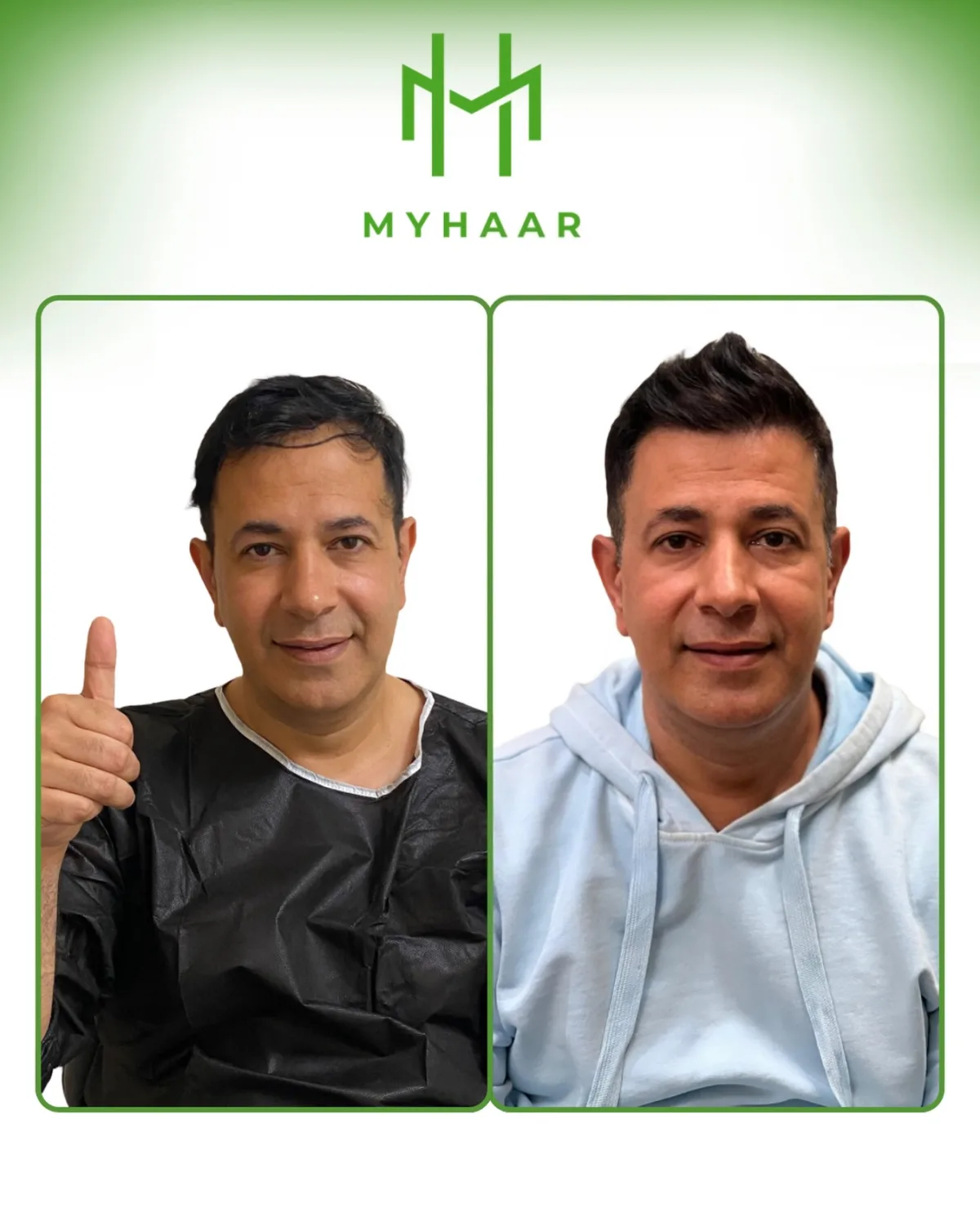
Female hair loss needs a different approach
Women rarely lose hair the way men do. Instead of a receding hairline and bald crown, most women experience diffuse thinning across the top of the scalp, a gradually widening parting or loss concentrated at the temples and hairline edges. The causes are also broader: alongside genetic female-pattern loss, thinning can stem from hormonal changes, thyroid conditions, iron deficiency, stress or years of tight hairstyles. That is why every treatment at MyHaar starts with diagnosis, not surgery. Our surgeons assess your pattern, medical history and, where needed, recommend further investigation with your physician first. A transplant only makes sense when the cause is understood and the donor area is stable; when it is not, we say so honestly.
When is a transplant the right choice for women?
A hair transplant works best for women with a defined, stable pattern of loss and a healthy donor area at the back of the head. Typical good candidates include women with a genetically high or receded hairline they would like lowered, traction alopecia from years of tight braids, buns or extensions, thinning at the temples, scarring from injuries, surgery or cosmetic procedures, and stable female-pattern loss concentrated along the parting. Diffuse thinning across the entire scalp, including the donor zone, responds less predictably to surgery; in those cases we often recommend PRP treatment or medical management first. This honest selection is exactly why our results, backed by an 18-month written growth guarantee, are consistent.
Unshaven and partial-shave techniques
For most women, shaving the head for a transplant is simply not an option, and at MyHaar it usually is not necessary. With unshaven and partial-shave DHI, only a discreet strip within the donor area is trimmed, hidden completely under the surrounding hair, while the recipient area is not shaved at all. Grafts are implanted between your existing hairs with Choi implanter pens, which allow precise control of angle, depth and direction without disturbing what you already have. Where larger graft numbers are needed, Sapphire FUE with a concealed donor window offers an efficient alternative. You leave the clinic looking much as you arrived, and can typically return to social life within days.
Your treatment day and recovery
On the day of your procedure, the surgeon finalises the design with you, whether that is a lowered hairline, a denser parting or restored temples, and photographs the starting point. Under local anaesthesia, grafts are extracted from the concealed donor zone and implanted over a session of roughly six to eight hours, with breaks. Recovery is discreet: light crusting along the treated area settles within about ten days, and shed transplanted hairs regrow from around month three to four. Density builds through months six to nine, with the mature result at twelve to eighteen months. Your package includes all medications, a PRP session to support growth, and scheduled follow-ups at our Den Haag clinic.
Why women choose MyHaar in Den Haag
Trust and discretion matter as much as technique. MyHaar combines more than 18 years of hair restoration experience and over 15,000 patients from 60+ countries with the security of the Dutch healthcare system: BIG-registered surgeons, IGJ supervision, ISHRS membership and ISO 9001:2015 certified processes. Consultations are private and unhurried, appointments can be planned around work and family, and there is no need to travel abroad or explain a sudden absence. From the first conversation to lifetime follow-up, you deal with the same medical team, in English, Dutch, Turkish, German or Arabic, with all-inclusive, transparent pricing and an 18-month written growth guarantee in your file.