
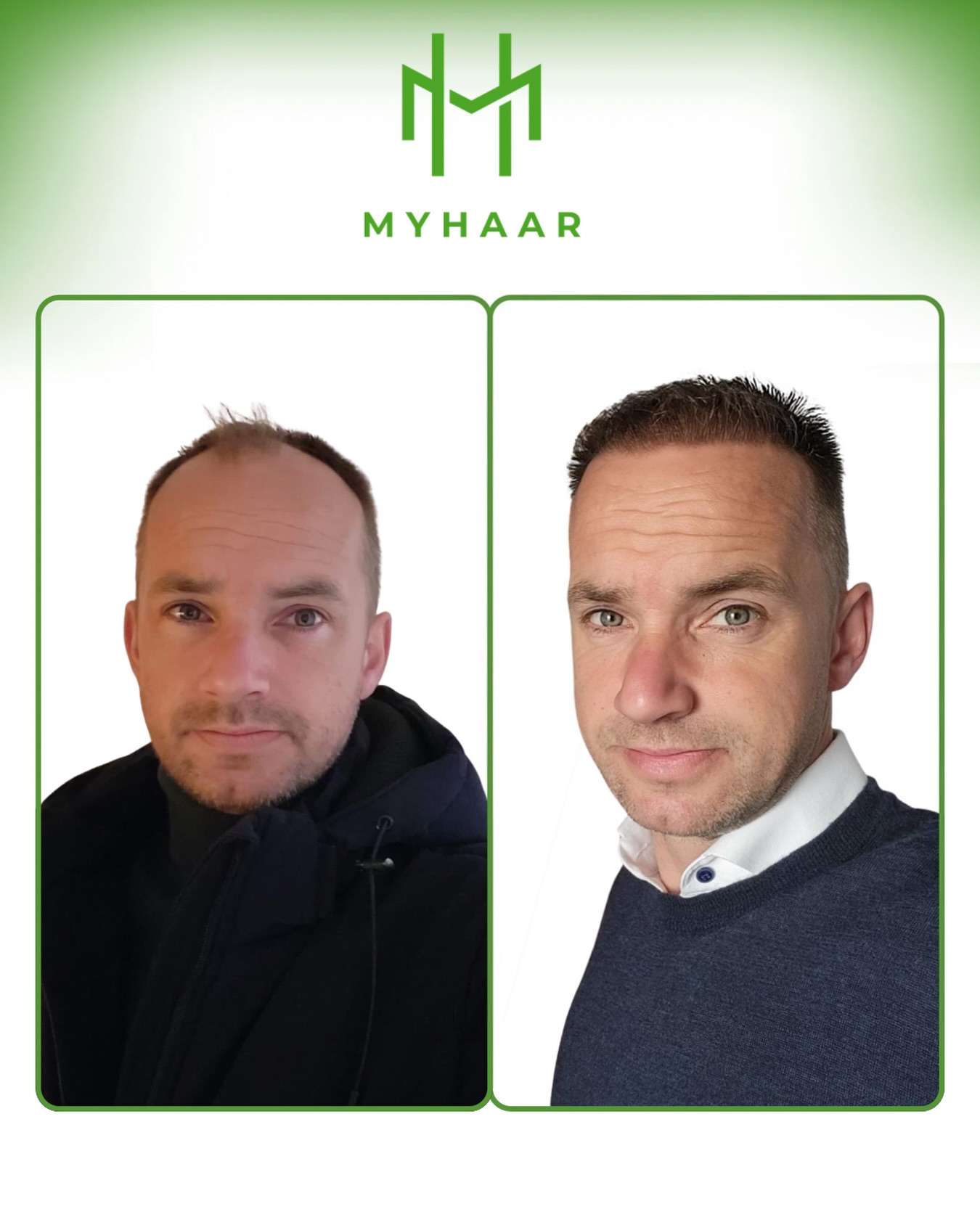
How many grafts do I need? It depends mainly on your Norwood stage: slightly receding temples (Norwood 2) often need around 800–1,500 grafts, a Norwood 3 roughly 1,500–2,500, and advanced baldness (Norwood 6–7) 4,500 grafts or more, often split over two sessions. These are rough estimates. The exact number depends on your donor area, hair characteristics and goals, and can only be set reliably at a personal consultation. Below you will find how such an estimate is made, and why graft count is not the only measure of a good result.
What is a graft, and why is it not the same as a hair?
A graft is a follicular unit: a natural group of 1 to 4 hairs growing together from the scalp. During a hair transplant these units are removed one by one from the donor area (back and sides of the head) and placed in the thinning or bald area. On average a graft holds about 2 to 2.5 hairs, although this varies from person to person.
That distinction matters when you compare quotes: 2,000 grafts equal roughly 4,000–5,000 hairs. A clinic that only quotes "hairs" can sound more generous than it is, so always ask for the number of grafts. Distribution matters too: single-hair grafts are used at the front hairline because they look most natural, while 3–4-hair grafts slightly further back build volume.
How many grafts do I need per Norwood stage?
Doctors use the Norwood scale to classify male pattern hair loss (androgenetic alopecia), from stage 1 (almost no loss) to stage 7 (only a horseshoe-shaped fringe at the sides and back). The ranges below are widely cited industry estimates. Treat them as a rough guide, not as medical advice or a quote.
| Norwood stage | What you see | Estimated grafts |
|---|---|---|
| Norwood 2 | Slight recession at the temples | approx. 800 – 1,500 |
| Norwood 3 | Clear temple recession, hairline moving back | approx. 1,500 – 2,500 |
| Norwood 3 vertex | Temple recession plus early crown thinning | approx. 2,000 – 3,000 |
| Norwood 4 | Hairline further back, balder crown, bridge of hair still present | approx. 2,500 – 3,500 |
| Norwood 5 | Bridge narrowing, front and crown merging | approx. 3,500 – 4,500 |
| Norwood 6 | Bridge gone, one large bald area | approx. 4,500 – 6,000 |
| Norwood 7 | Only a narrow fringe at the sides and back | approx. 5,500 – 7,000+ (often limited by donor supply) |
Two people at the same stage can still need very different numbers. At higher stages the donor supply is usually the limiting factor: the question becomes not "how many do I need" but "how many can safely be taken".
Factors that change your graft count
- Donor density: the number of follicular units per cm² at the back and sides. A dense donor area allows more grafts without visible thinning.
- Hair calibre: thick hair covers more scalp than fine hair, so fewer grafts achieve a full look.
- Curl and wave: wavy or curly hair lies over the scalp and looks fuller than straight hair with the same graft count.
- Skin–hair contrast: dark hair on light skin shows gaps more easily and usually needs more density than when hair and skin tones are closer.
- Your goal: a framed, fresh hairline or full coverage from front to crown can differ by thousands of grafts.
- Age and future loss: pattern hair loss often continues. In younger patients the plan must leave donor hair for later. A doctor may also discuss medication such as finasteride or minoxidil to protect your remaining hair; that is always a medical decision made with a doctor.
Your donor area is finite
Hair at the back and sides is generally less sensitive to the hormone DHT, which is why it usually keeps growing after transplantation. But this area is not unlimited: only part of it can be harvested before it looks thin. Lifetime donor capacity varies widely; for an average donor area it is often described as a few thousand grafts in total, and much less when the donor area is weak. That is why a hairline designed too low or too wide at a young age is a common mistake: it uses grafts you may need later for the crown and may not suit an older face.
Grafts per session: DHI, Sapphire FUE and MyHaar FUE
| Technique | Maximum per session (guide) | Best suited for |
|---|---|---|
| DHI (Choi implanter pens) | up to approx. 3,500 grafts | Front hairline, no-shave for women, eyebrows |
| Sapphire FUE (sapphire blades) | up to approx. 5,500 grafts | Large areas and higher Norwood stages |
| MyHaar FUE (combined) | depends on the plan | Sapphire FUE for volume plus a DHI-finished hairline |
DHI hair transplant places each graft directly with an implanter pen, giving fine control over angle, depth and direction; ideal for hairlines but slower per graft. Sapphire FUE opens fine channels first, which makes larger numbers feasible in one day. A standard FUE or DHI procedure takes 6–8 hours; the combined MyHaar FUE protocol about 7–9 hours, as a day procedure under local anaesthesia.
One session or two?
For Norwood 2–4 one session is usually enough; for Norwood 5 it depends on your donor area and goals. At Norwood 6–7 a second session is often necessary or sensible. The front then gets priority in the first session because it frames the face. A second session, for example for the crown, typically follows once the first result is clearly visible, often after about a year.
How MyHaar determines your number of grafts
MyHaar is a team of Turkish hair-restoration specialists who perform procedures in Den Haag. You get Turkish expertise without flying to Turkey: treatment, aftercare and check-ups all take place in the Netherlands, under Dutch rules and in your own language. Your graft count is set at a free surgeon consultation, in person or by video:
- Hair loss analysis: Norwood stage, pattern and quality of your remaining hair.
- Donor assessment: density, calibre and what can responsibly be harvested now and later.
- Hairline design: drawn together with you to suit your face and age.
- Zone-by-zone planning: hairline, mid-scalp and crown each get their own density and graft count.
- Written quote: a personal price valid for 30 days, with no hidden costs.
Prices start from €1,750 for Sapphire FUE and €2,500 for DHI, including a pre-op blood test, one PRP session, medication and aftercare kit, follow-ups at 3, 6, 12 and 18 months and an 18-month written growth guarantee. See pricing and what is included.
Why more grafts is not automatically better
- Graft survival: careful extraction, short time outside the body and gentle handling matter. 2,500 grafts that take well beat 4,000 poorly handled ones.
- Placement: angle, direction and depth decide whether hair falls naturally.
- Density design: a soft, irregular hairline with a denser zone behind looks more natural than even spacing.
- Donor preservation: over-harvesting can visibly thin the back of your head and leaves little for the future.
FAQ: how many grafts do I need?
How many hairs are in 2,000 grafts?
With 1–4 hairs per graft and an average of about 2–2.5, 2,000 grafts equal roughly 4,000–5,000 hairs.
How many grafts for just the hairline?
Restoring the front hairline and temples often takes somewhere between 1,000 and 2,000 grafts, depending on how far forward the line comes and how dense you want the front.
Can I calculate my graft count myself?
A table or online calculator gives a first indication, but donor quality and future hair loss can only be judged by a specialist. You can send photos for a free assessment.
Will all grafts grow?
No clinic can guarantee every graft takes. That is why MyHaar gives an 18-month written growth guarantee: grafts that do not take are re-implanted without a surgical fee. Regrowth usually starts at 3–6 months; the final result shows at 12–18 months.
What if my donor area is weak?
A doctor may advise fewer grafts with priority for the front, or first strengthening existing hair, for example with PRP or medication after medical advice. Sometimes a transplant is not advisable (yet), and you will be told so honestly.
Does graft count decide the price?
Graft count and technique play a role, but your final price is in a personal written quote after the consultation. Note that Dutch basic health insurance normally does not reimburse cosmetic hair transplants.
Want to know exactly how many grafts you need? Book a free consultation with hairline design at our clinic in Den Haag or by video, or message us on WhatsApp. You will receive honest advice and a written quote, with no obligation.